


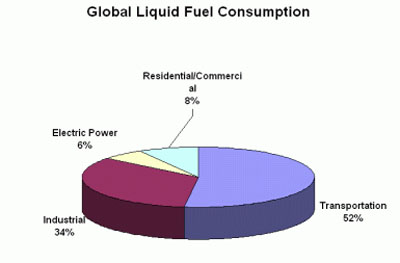
Together, the transportation and industrial sectors account for around 86% of global oil use.
As you can see in the pie graph below, remaining demand for liquid fuel is evenly split between electric power generation and heat in residential and commercial applications.
Source: Energy Information Administration
Of all of these uses, transportation is the most important from an oil demand perspective; natural gas, nuclear and coal are all well-established alternatives for electric power generation. Coal and natural gas are also both widely used in industrial applications; natural gas liquids (NGL) derived from gas will play a larger role in satisfying industrial demand in coming years.
Finally, natural gas, propane and electricity can all replace oil in residential and commercial heating demand. But the global transportation market lacks immediate and established alternatives.
Natural gas will play a larger role in meeting global transportation demand in coming years, but this market is in its infancy: Of the roughly 28 quadrillion BTUs the U.S. transportation consumes each year, 26.8 quadrillion comes from petroleum and just 0.03 comes from compressed natural gas (CNG) burned in buses, cars and trucks.
Oil's dominance of the global transportation market is the primary reason crude consistently trades at such a huge price premium to most fossil fuels.
Source: Bloomberg
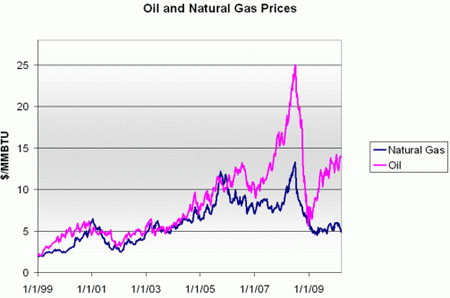
To create this graph, I converted the price of West Texas Intermediate (WTI) crude oil and UK-traded gas prices into U.S. dollars per million British thermal units (MMBTU) to make them comparable to gas prices at the Henry Hub. The current price of oil is just under USD14 per MMBTU compared to USD4.9 per MMBTU for natural gas (based on the 12-month gas strip). Thus, natural gas currently commands roughly one-third the value of oil on an energy-equivalent basis—near record levels. The average going back to the end of 1998 is a discount of less than 24%.
As you can see in the pie graph below, remaining demand for liquid fuel is evenly split between electric power generation and heat in residential and commercial applications.
Source: Energy Information Administration
Of all of these uses, transportation is the most important from an oil demand perspective; natural gas, nuclear and coal are all well-established alternatives for electric power generation. Coal and natural gas are also both widely used in industrial applications; natural gas liquids (NGL) derived from gas will play a larger role in satisfying industrial demand in coming years.
Finally, natural gas, propane and electricity can all replace oil in residential and commercial heating demand. But the global transportation market lacks immediate and established alternatives.
Natural gas will play a larger role in meeting global transportation demand in coming years, but this market is in its infancy: Of the roughly 28 quadrillion BTUs the U.S. transportation consumes each year, 26.8 quadrillion comes from petroleum and just 0.03 comes from compressed natural gas (CNG) burned in buses, cars and trucks.
Oil's dominance of the global transportation market is the primary reason crude consistently trades at such a huge price premium to most fossil fuels.
Source: Bloomberg
To create this graph, I converted the price of West Texas Intermediate (WTI) crude oil and UK-traded gas prices into U.S. dollars per million British thermal units (MMBTU) to make them comparable to gas prices at the Henry Hub. The current price of oil is just under USD14 per MMBTU compared to USD4.9 per MMBTU for natural gas (based on the 12-month gas strip). Thus, natural gas currently commands roughly one-third the value of oil on an energy-equivalent basis—near record levels. The average going back to the end of 1998 is a discount of less than 24%.