


Six years of data show that global production of oil started to plateau in 2005. But there are other ways to measure the world's faltering ability to increase oil supply. We can show the increase in cost structure, as the capital required to bring on the new barrel rises; show the decline rates from existing fields; quantify how much oil comes from expensive, technically challenging fields such as tar sands or global offshore; or show oil's share as a percentage of total world energy consumption.
Given that the annual BP Statistical Review was released yesterday, I made up the following chart to show oil's contribution to world energy use, on a BTU basis:
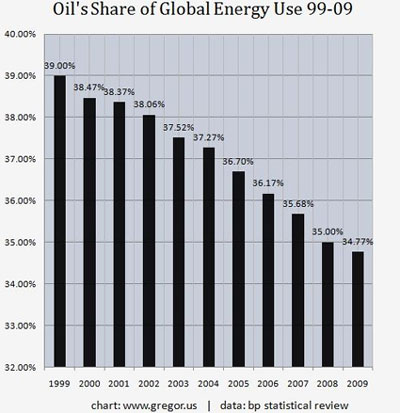
Oil still provides the largest share of primary energy, ahead of coal and natural gas. But as you can see from the chart, its share is not exactly in gentle decline. The deficit is not being made up by natural gas, or renewables, or hydro, or nuclear. Indeed, if you're a regular reader of this blog, you'll already know the deficit is being met by coal. I thought the Bloomberg.com writers described this well just yesterday, upon the release of the BP Statistical Review:
Given that the annual BP Statistical Review was released yesterday, I made up the following chart to show oil's contribution to world energy use, on a BTU basis:
Oil still provides the largest share of primary energy, ahead of coal and natural gas. But as you can see from the chart, its share is not exactly in gentle decline. The deficit is not being made up by natural gas, or renewables, or hydro, or nuclear. Indeed, if you're a regular reader of this blog, you'll already know the deficit is being met by coal. I thought the Bloomberg.com writers described this well just yesterday, upon the release of the BP Statistical Review:
"Coal's share of global energy consumption rose last year to its highest level since 1970 as use of natural gas fell the most on record, a tendency that may continue, BP Plc said in a report. Coal accounted for 29% of world energy use, BP said today in its annual Statistical Review of World Energy. The report measures consumption of oil, gas, coal, nuclear energy and hydroelectricity."The inexorable advance of coal and the shrinking share of oil provides better understanding of peak oil. For a world that has enjoyed oil's high energy density for the past 70 years, the transition to lower energy-density sources presents "a problem," to say the least. The debate over whether the world has peaked in oil supply, however, can now be laid to rest.