


It's odd that people believe something truly new is possible in the world of global oil discovery. Oil deposits on earth follow a fairly well defined pattern: A handful of giant fields, and a great number of smaller fields. Unsurprisingly, 150 years of oil exploration and discovery has done nothing to upend this distribution. The giant fields were all found earlier in the oil age. Now we are into the latter part of the oil age, when the large fields have peaked and gone into decline, and we spend more capital, more labor and more energy to extract oil from the smaller fields.
A nice example of the pattern is Mexico. They inherited a giant: Cantarell. But now that Cantarell has been in fast decline since its peak in 2004, Mexico is left with a complex of smaller fields called Ku-Maloob-Zaap, and also the very low quality Chicontepec. It's kind of sad that Mexico's Energy Ministry has been touting for years the promise of Chicontepec. It's a dog's breakfast of an oil field, with its deposits widely dispersed and hard to extract. After all this time, it produces a feeble 40 thousand barrels a day.
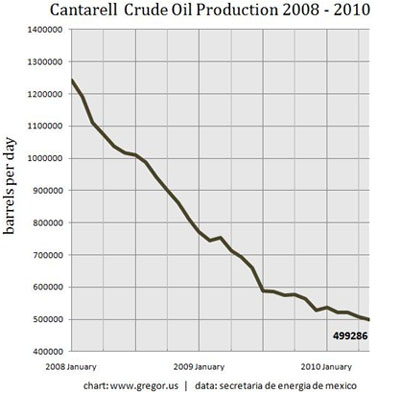
As you can see from the chart, Cantarell Crude Oil Production 2008–2010, Mexico's single giant finally slipped below 500 thousand barrels per day (kbpd) of production in May, to 499,286 kbpd. It's still pretty astonishing to reflect that just two years ago, Cantarell was still producing a million barrels per day. The Mexican government, like the average layperson, continues to trade publicly in the idea that some new discovery could occur in Mexico that would alter the country's production decline. But unlike the layperson, PEMEX knows better. (Indeed, insider reports on PEMEX indicate they've known for years).
A nice example of the pattern is Mexico. They inherited a giant: Cantarell. But now that Cantarell has been in fast decline since its peak in 2004, Mexico is left with a complex of smaller fields called Ku-Maloob-Zaap, and also the very low quality Chicontepec. It's kind of sad that Mexico's Energy Ministry has been touting for years the promise of Chicontepec. It's a dog's breakfast of an oil field, with its deposits widely dispersed and hard to extract. After all this time, it produces a feeble 40 thousand barrels a day.
As you can see from the chart, Cantarell Crude Oil Production 2008–2010, Mexico's single giant finally slipped below 500 thousand barrels per day (kbpd) of production in May, to 499,286 kbpd. It's still pretty astonishing to reflect that just two years ago, Cantarell was still producing a million barrels per day. The Mexican government, like the average layperson, continues to trade publicly in the idea that some new discovery could occur in Mexico that would alter the country's production decline. But unlike the layperson, PEMEX knows better. (Indeed, insider reports on PEMEX indicate they've known for years).