

Mark Skousen, Chairman, Investment U, explains why he believes uranium is poised to make significant gains.
In the past two weeks, gold and other commodities have dropped sharply after a huge run-up.
But one “yellow” commodity continues to defy gravity, and is likely to climb even higher: Uranium.
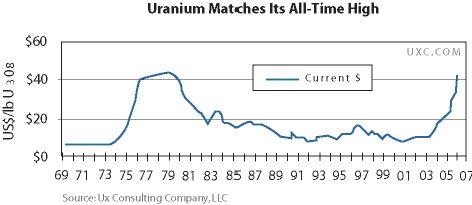
Today, the price is $43 a pound. It caps a 437% rise since 2000, when uranium cost just $8. In 2005, uranium demand outstripped supply by around 100 million pounds. Take a look at the historical price of uranium in the chart below.
We last looked at investing in uranium stocks in September, forecasting a “never-ending energy crisis,” and a gradual shift to the nuclear power option – the “preferred energy alternative, better and cheaper than coal, water, wind and fuel cells.” Since then, uranium prices have jumped more than 30%.
And now it’s time for an update…
Three Factors Favor A Continuing Uranium Stock Bull Market
1. The primary driver behind this year’s sharp run-up in uranium, the fuel for nuclear power plants, is the dramatic increase in the number of contracts.
Last year, the uranium term market posted a dramatic record, more than doubling the previous reported record in 1996, with over 250 million pounds. 2006 could prove to be even higher…
With an increasingly urgent need for America to reduce its “addiction” to Middle East oil, the trend is still upward for uranium. Governments and corporations are already spending billions searching for viable alternative energy sources. And while solar power and ethanol fuel have seen advances, neither will meet current global energy demand.
Nuclear power is the one resource available to meet growing electricity demand throughout the world, and it could become the world’s preferred fuel.
According to the Nuclear Energy Institute, nuclear power supplies 19.9% of electricity used in America and 17% used across the world. With the federal government working to build new plants across the nation, nuclear power could easily double as a percentage of total electricity supply over the next few years.
Russia has also unveiled plans to build 24 additional nuclear reactors, and China has scheduled building more than 30 reactors (two 1,000-megawatt plants every year for the next 20 years). India is also going nuclear at a rapid pace. Worldwide, there are 160 power plants proposed or currently under construction.
2. There is increasing speculative interest in uranium stocks by hedge funds.
This year, 25% of uranium has been purchased by hedge fund players. They have also been big investors in Cameco stock (NYSE: CCJ), one of the world’s premier uranium producers.
Speculative demand, however, is a two-edged sword – it can cause prices to skyrocket, but it can also create an unstable market. Uranium – and uranium stocks – could suffer from a sharp correction from time to time. (Speculative buying is notoriously volatile compared to the fundamentals of supply and demand.)
But in addition to getting special attention from hedge funds, uranium’s getting some key public support…
3. Previous critics of nuclear power are coming on board.
Last week, British Prime Minister Tony Blair reversed his 2003 negative assessment of nuclear power as an “unattractive option.” In a speech to the Confederation of British Industry, Blair stated that replacement of Britain’s nuclear power stations is “back on the agenda with a vengeance.” He claimed it would be “a dereliction of my duty” if he neglected the issue, citing global warming, energy security and the high cost and unreliability of wind and solar power as key factors.
Another significant sea change is that the anti-nukes are switching sides… One of the founders of Greenpeace, Patrick Moore, recently changed his mind in an op-ed piece in The Washington Post. Moore now favors nuclear energy as “the only large-scale, cost-effective energy source that can reduce greenhouse emissions while continuing to satisfy a growing demand for power.” Moore feels that nuclear energy can now be produced safely, and therefore is a better alternative energy solution than solar energy, fuel cells, etc.
Prospering From Higher Prices
The developments (increasing demand and limited supplies) mean uranium’s record high could merely be the beginning – especially considering that uranium sold for an inflation-adjusted high of $98 per pound in the early 1980s, far below current record highs around $43.
Nine months ago, when I first wrote about the yellow commodity, my favorite blue chip uranium stock, Cameco (NYSE: CCJ), has almost doubled in price. The stock could double again, though I suspect it will be a bumpy ride for speculators.
Dr. Mark Skousen is a professional economist, financial advisor, university professor and author of more than 20 books. Dr. Skousen has taught economics and finance at Columbia Business School, Barnard College at Columbia University and Rollins College in Winter Park, Florida. In April 2005, Grantham University honored Dr. Skousen by renaming its School of Business “The Mark Skousen School of Business.” In 2001-02, he was president of the Foundation of Economic Education (FEE) in New York. In 2005, he became the chairman of Investment U, one of the largest investment e-letters in the country, with more than 300,000 subscribers.
In the past two weeks, gold and other commodities have dropped sharply after a huge run-up.
But one “yellow” commodity continues to defy gravity, and is likely to climb even higher: Uranium.
Today, the price is $43 a pound. It caps a 437% rise since 2000, when uranium cost just $8. In 2005, uranium demand outstripped supply by around 100 million pounds. Take a look at the historical price of uranium in the chart below.
We last looked at investing in uranium stocks in September, forecasting a “never-ending energy crisis,” and a gradual shift to the nuclear power option – the “preferred energy alternative, better and cheaper than coal, water, wind and fuel cells.” Since then, uranium prices have jumped more than 30%.
And now it’s time for an update…
Three Factors Favor A Continuing Uranium Stock Bull Market
1. The primary driver behind this year’s sharp run-up in uranium, the fuel for nuclear power plants, is the dramatic increase in the number of contracts.
Last year, the uranium term market posted a dramatic record, more than doubling the previous reported record in 1996, with over 250 million pounds. 2006 could prove to be even higher…
With an increasingly urgent need for America to reduce its “addiction” to Middle East oil, the trend is still upward for uranium. Governments and corporations are already spending billions searching for viable alternative energy sources. And while solar power and ethanol fuel have seen advances, neither will meet current global energy demand.
Nuclear power is the one resource available to meet growing electricity demand throughout the world, and it could become the world’s preferred fuel.
According to the Nuclear Energy Institute, nuclear power supplies 19.9% of electricity used in America and 17% used across the world. With the federal government working to build new plants across the nation, nuclear power could easily double as a percentage of total electricity supply over the next few years.
Russia has also unveiled plans to build 24 additional nuclear reactors, and China has scheduled building more than 30 reactors (two 1,000-megawatt plants every year for the next 20 years). India is also going nuclear at a rapid pace. Worldwide, there are 160 power plants proposed or currently under construction.
2. There is increasing speculative interest in uranium stocks by hedge funds.
This year, 25% of uranium has been purchased by hedge fund players. They have also been big investors in Cameco stock (NYSE: CCJ), one of the world’s premier uranium producers.
Speculative demand, however, is a two-edged sword – it can cause prices to skyrocket, but it can also create an unstable market. Uranium – and uranium stocks – could suffer from a sharp correction from time to time. (Speculative buying is notoriously volatile compared to the fundamentals of supply and demand.)
But in addition to getting special attention from hedge funds, uranium’s getting some key public support…
3. Previous critics of nuclear power are coming on board.
Last week, British Prime Minister Tony Blair reversed his 2003 negative assessment of nuclear power as an “unattractive option.” In a speech to the Confederation of British Industry, Blair stated that replacement of Britain’s nuclear power stations is “back on the agenda with a vengeance.” He claimed it would be “a dereliction of my duty” if he neglected the issue, citing global warming, energy security and the high cost and unreliability of wind and solar power as key factors.
Another significant sea change is that the anti-nukes are switching sides… One of the founders of Greenpeace, Patrick Moore, recently changed his mind in an op-ed piece in The Washington Post. Moore now favors nuclear energy as “the only large-scale, cost-effective energy source that can reduce greenhouse emissions while continuing to satisfy a growing demand for power.” Moore feels that nuclear energy can now be produced safely, and therefore is a better alternative energy solution than solar energy, fuel cells, etc.
Prospering From Higher Prices
The developments (increasing demand and limited supplies) mean uranium’s record high could merely be the beginning – especially considering that uranium sold for an inflation-adjusted high of $98 per pound in the early 1980s, far below current record highs around $43.
Nine months ago, when I first wrote about the yellow commodity, my favorite blue chip uranium stock, Cameco (NYSE: CCJ), has almost doubled in price. The stock could double again, though I suspect it will be a bumpy ride for speculators.
Dr. Mark Skousen is a professional economist, financial advisor, university professor and author of more than 20 books. Dr. Skousen has taught economics and finance at Columbia Business School, Barnard College at Columbia University and Rollins College in Winter Park, Florida. In April 2005, Grantham University honored Dr. Skousen by renaming its School of Business “The Mark Skousen School of Business.” In 2001-02, he was president of the Foundation of Economic Education (FEE) in New York. In 2005, he became the chairman of Investment U, one of the largest investment e-letters in the country, with more than 300,000 subscribers.